
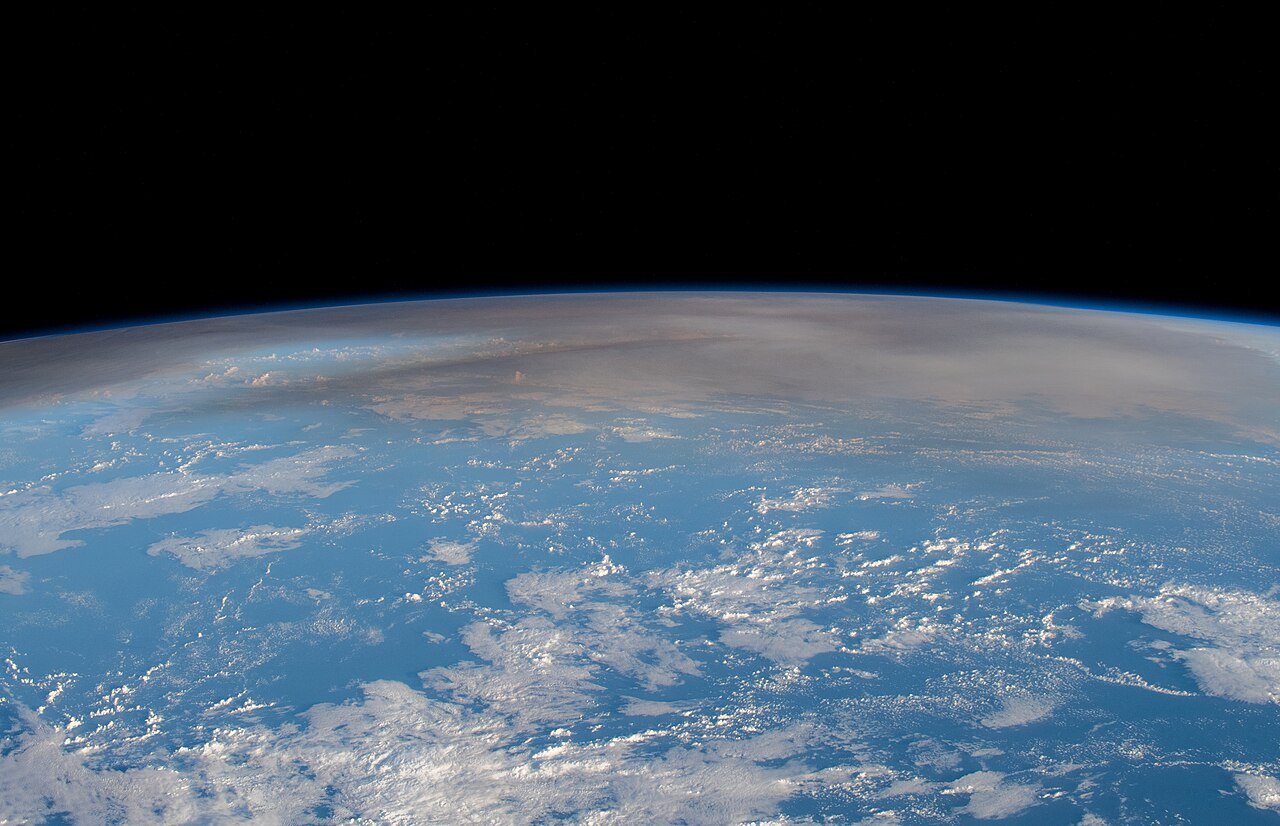
When the Hunga Tonga-Hunga Ha’apai volcano exploded beneath the South Pacific in January 2022, it set off the most powerful atmospheric eruption ever recorded. Now scientists studying satellite data have uncovered something nobody expected: for more than a week afterward, the giant volcanic cloud was quietly destroying methane – including some of the methane the volcano itself had just released.
The clue was formaldehyde, a short-lived chemical that appears when methane breaks apart in the atmosphere. Satellites measured record-high concentrations of it inside the plume. Because formaldehyde survives for only a few hours, tracking it for ten days – all the way to South America – proved the cloud must have been destroying methane continuously the entire time.
“It is known that volcanoes emit methane during eruptions, but until now it was not known that volcanic ash is also capable of partially cleaning up this pollution,” said Maarten van Herpen of Acacia Impact Innovation, first author of the study published in Nature Communications.
The chemistry works like this. The underwater eruption blasted enormous amounts of salty seawater and ash into the stratosphere. Sunlight striking that mixture released highly reactive chlorine atoms, which attacked methane molecules and helped break them apart. Researchers first identified this iron-salt-aerosol chemistry in 2023, when Saharan dust crossing the Atlantic mixed with sea salt from breaking waves – but nobody had ever seen it happen inside a volcanic plume, high in the stratosphere where conditions are entirely different.
The numbers are staggering. The eruption released around 300 gigagrams of methane, roughly the annual output of more than two million cows, while the plume removed about 900 megagrams of methane per day – comparable to the daily emissions of another two million cows.
The discovery matters far beyond one volcano. Methane drives roughly a third of current global warming and traps about 80 times more heat than carbon dioxide over a 20-year period, yet it lingers in the atmosphere for only about a decade. That short lifetime is why researchers call methane reduction an emergency brake on climate change. Showing that nature can accelerate methane destruction on its own is already inspiring work on whether the volcano’s trick could ever be copied deliberately – part of a wider effort to tame the gas that ranges from atmospheric chemistry to industrial catalysts that convert methane into useful chemicals. It is also a reminder that Earth’s climate system still holds surprises, from the deep history written in our planet’s rocks to the chemistry of a single eruption cloud.
Sources
ScienceDaily: Scientists stunned as volcano cloud starts destroying methane
Nature Communications (journal)
Featured image: NASA/Kayla Barron, ISS Expedition 66, public domain.