
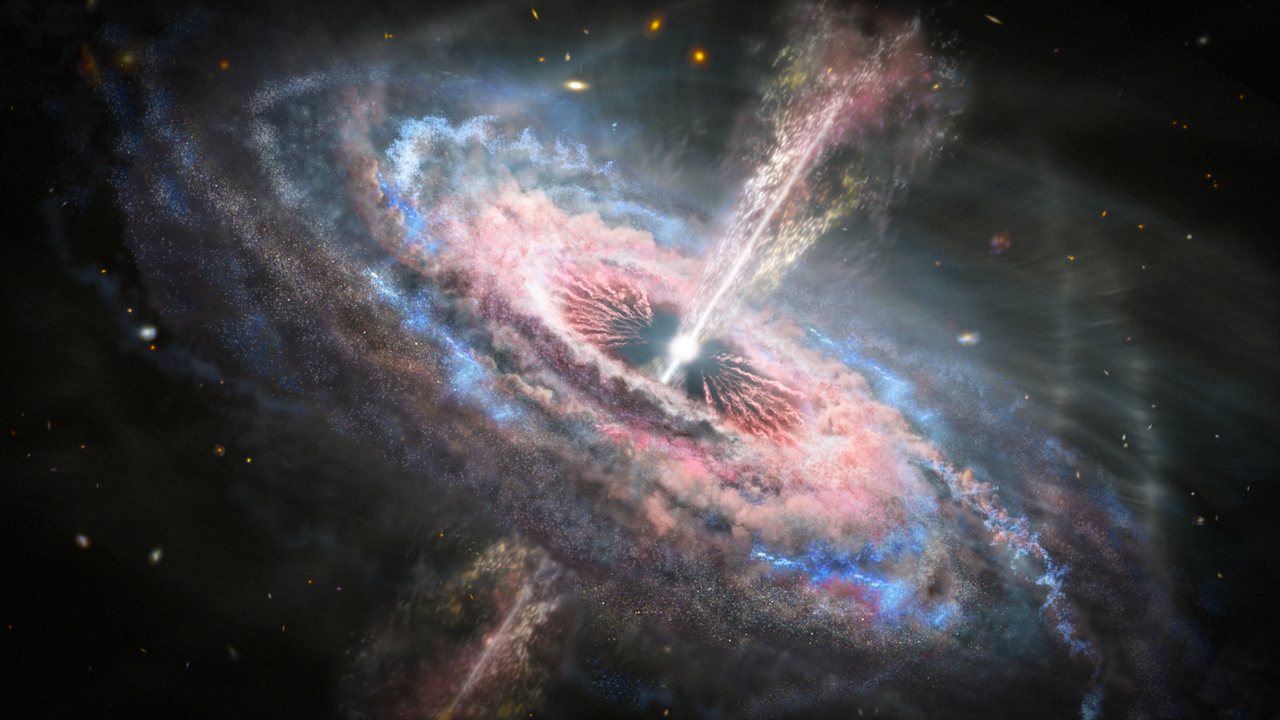
Black holes are famous for pulling matter in, but new observations show they are even more violent when pushing gas out. Winds driven by a supermassive black hole carry roughly 100 times more energy than scientists had estimated, stirring gas across some 300,000 light-years – far beyond the galaxy that hosts it.
The finding comes from XRISM, an X-ray astronomy satellite operated by the Japan Aerospace Exploration Agency with NASA participation. A team led by Satoshi Yamada of Tohoku University used it to study the quasar H1821+643 – a brilliantly glowing disk of gas being devoured by a supermassive black hole – about 3.4 billion light-years from Earth in the constellation Draco.
The quasar sits inside a galaxy cluster, where it heats enormous volumes of gas that glow in X-rays. By analyzing emission lines from iron ions, the researchers measured how that gas was moving. XRISM’s high-precision spectrometer revealed turbulence spreading violently across a vast region and extending well past the host galaxy into the cluster itself.
The energy contained in that turbulence turned out to be about 100 times greater than previous estimates – comparable, the team says, to the output of several billion supernova explosions. “For the first time, we have shown that black holes influence the broader cosmic environment through a shock wave of astonishing power,” Yamada said. The results appear in the journal Nature Astronomy.
The discovery reshapes how astronomers think about black holes. Rather than acting as isolated drains at the centers of galaxies, they behave as engines that pump energy and gas deep into surrounding space, potentially shaping which galaxies keep forming stars and which fade into quietness. The result is the latest reminder that modern observatories keep rewriting the cosmic rulebook – from a magnetar’s light confirming a 90-year-old quantum prediction to the slow decline of star formation across the universe. Future XRISM observations are expected to clarify exactly how black holes move matter and elements through the cosmos.
Sources
ScienceDaily: Supermassive black hole winds are 100 times more powerful than scientists thought
Featured image: NASA artist’s concept of a quasar outflow, public domain.